Infrastructure
The Next American Century Is Ours to Build
AI, American production, and the infrastructure that can turn national strength into family prosperity.
Updated September 18, 2026.
America’s next great century should mean a better everyday life: a home you can afford, work that lets you get ahead, and the confidence that your children will have more opportunities than you did. AI and robotics could help American businesses make more of what we need at home. That ambition will require electricity, computing infrastructure, factories, and skilled workers. The question is how to make those investments pay off for the people who live and work around them.
The public has turned skeptical
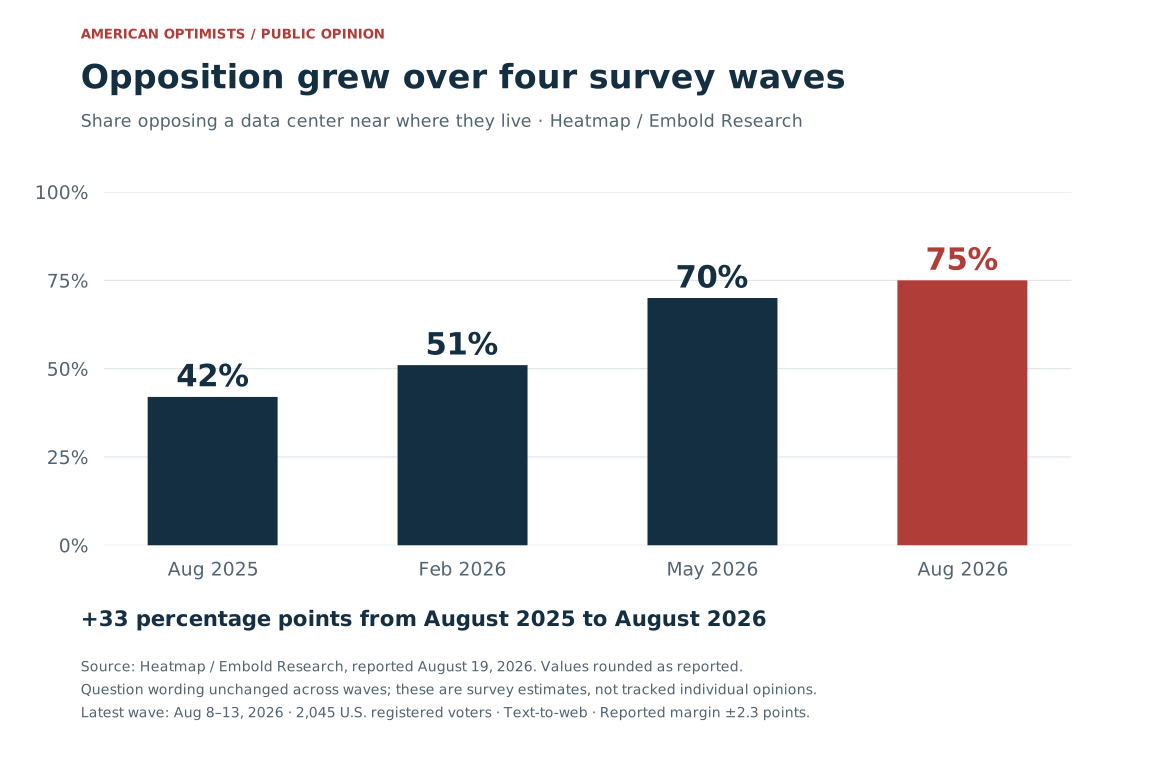
For communities considering a new data center, the questions are immediate: what will happen to electricity bills, water supplies, and nearby land—and who will benefit? Heatmap/Embold surveys using unchanged question wording found opposition to a nearby data center rising from approximately 42% in August 2025 to 75% in August 2026. That is a 33-percentage-point increase across the survey series. Heatmap reporting, August 19, 2026.
Open the trend chart at full size.
Graphic 1. Local opposition across four survey waves. Original chart by American Optimists using reported Heatmap/Embold estimates. Latest wave: August 8–13, 2026; 2,045 U.S. registered voters; text-to-web; reported margin ±2.3 percentage points. The series measures survey responses, not tracked changes among the same individuals. Earlier estimates are rounded as reported. Publisher’s original interactive graphic.
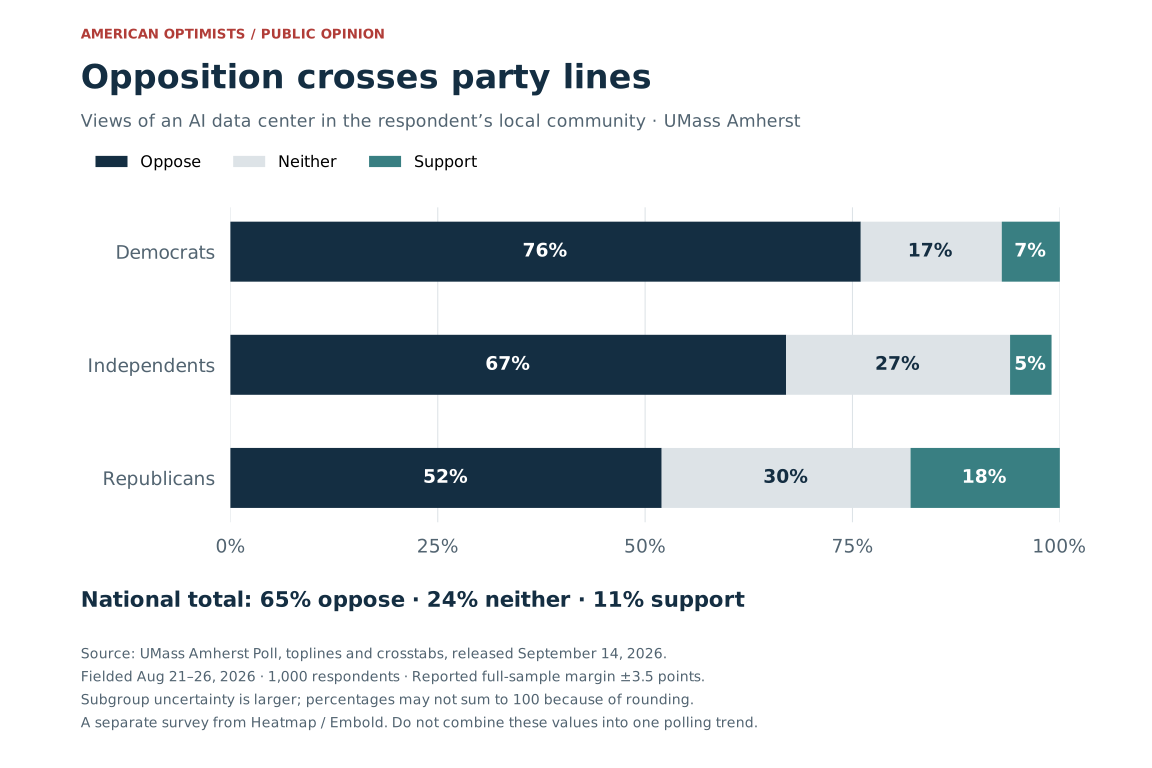
The opposition crosses party lines. In a separate UMass Amherst survey fielded August 21–26 and released September 14, 76% of Democrats, 67% of independents, and 52% of Republicans opposed an AI data center in their local community. This is a snapshot of party differences, not an additional wave of the Heatmap series. UMass report.
Open the party chart at full size.
Graphic 2. Local AI data-center sentiment by party. Original chart by American Optimists using UMass toplines and crosstabs. Full sample: 1,000 respondents, reported margin ±3.5 points; subgroup uncertainty is larger. Rounding explains the independent row totaling 99%. Original tables, pages 1–3.
The consequences extend to the conditions under which construction can proceed. Pennsylvania Governor Josh Shapiro removed data centers from fast-track permitting and announced requirements covering local approval, infrastructure costs, workforce benefits, and environmental protection. His announcement explicitly connected the action to residents’ concerns. Pennsylvania’s August 18 announcement.
Pennsylvania still provides a path for qualifying projects. To judge a proposed data center, residents need a clear account of what their community would gain and what it would have to pay.
What a community can gain
One of the more encouraging documents in America’s technology debate is a county budget.
In Mecklenburg County, Virginia, officials call it a “data center dividend.” The county’s adopted 2025–26 budget included about $1.5 million in tax reductions. It eliminated a vehicle-registration fee and the county’s electric-consumer utility tax, and lowered personal-property tax rates while continuing to cover debt on the county’s high school and middle school complex. Mecklenburg County’s adopted budget.
For residents, the benefit is concrete: lower local taxes while the county continues to meet its school-debt obligations.
Prineville, Oregon, offers another version. Local reporting this summer put electricity-related franchise fee revenue at nearly $11 million, up from roughly $430,000 in 2011. Officials described greater financial stability, while seeking stronger terms for future data-center agreements. These are fees, not property-tax collections, and the distinction matters when assessing the bargain. The Source’s local reporting.
Prineville’s experience raises the question every town should ask: after incentives and public costs, what does the agreement leave for residents?
What communities need answered
Pew’s January survey adds a useful distinction. Americans were more likely to see benefits than harms for local jobs and tax revenue, while giving much more negative assessments of energy costs and environmental effects. People can recognize an opportunity and still worry about the bill. Pew Research Center.
Those worries deserve answers. Virginia’s legislative research agency documented real problems from continuous noise at some sites, even as most generated no noise complaints. It also found that a typical data-center building employs relatively few ongoing workers compared with its construction workforce. A ribbon-cutting promise should distinguish temporary jobs from lasting employment. Virginia’s JLARC study.
Electricity is a substantial constraint. Berkeley Lab estimated that U.S. data centers consumed 176 terawatt-hours in 2023, or 4.4% of the nation’s electricity. Its range for 2028 was much higher. These facilities need actual generation and transmission, and communities deserve to know who finances both. Berkeley Lab’s energy report.
Better terms are possible
The encouraging part is that communities have tools. Virginia’s utility regulator has approved protections including a separate rate class for large customers and long payment commitments for new qualifying contracts beginning in 2027. Such arrangements aim to keep households from being left with infrastructure bills if a giant customer’s plans change. Their performance will still need scrutiny. Virginia State Corporation Commission.
Water offers an example of engineering changing the bargain. In Quincy, Washington, the city and Microsoft built a utility that treats data-center cooling water for reuse. EPA’s case study estimates annual potable-water savings of 138 million gallons. The system became operational in 2021. That is a specific improvement with a stated baseline, rather than a blanket assurance that water use does not matter. EPA’s Quincy case study.
These examples suggest a sensible standard for new projects. Put the community’s dividend in writing. Publish projected taxes and fees after incentives. Specify what the developer must pay for power and water infrastructure. Measure the effects neighbors will experience. Report what actually happens after the opening ceremony.
What the Chinese influence evidence shows
There is also a foreign-influence story, and precision matters there as well.
In June, OpenAI, which has its own commercial stake in AI infrastructure, described a likely China-origin operation that used fabricated American personas and AI-generated material to amplify criticism of U.S. data centers. The company connected the operators to a likely private technology team serving Chinese provincial-government clients. That is a serious account of attempted covert influence. OpenAI’s case study.
But OpenAI also said it found no meaningful spread beyond the operation’s own activity. It described actors exploiting concerns already present in American communities. The evidence does not show that China created those concerns or caused most opposition. OpenAI’s June 10 findings.
Residents should never have to prove their patriotism before asking about a water supply or electricity bill. A community debating a major industrial project is doing ordinary democratic work. Transparent terms and measurable results make that debate harder for any propagandist to distort.
The opportunity is worth taking seriously. A town can gain resources that let it repair infrastructure, keep public commitments, or ask less from its residents. Success should be counted in those everyday freedoms.
Mecklenburg’s budget shows what that can look like. The next community should arrive at the negotiating table expecting a dividend of its own—and a clear account of what it will cost.